
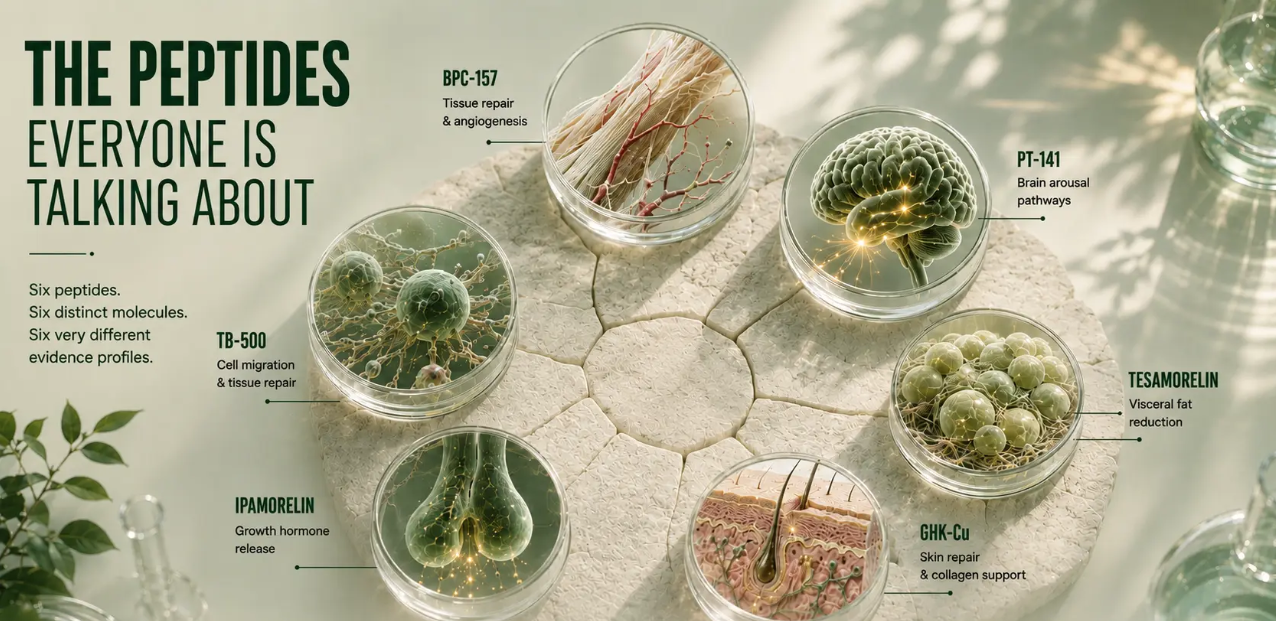
Peptides have exploded into social media feeds, clinics, and health forums. While GLP-1 receptor agonists like semaglutide dominate headlines, a different class—BPC-157, TB-500, PT-141, Ipamorelin, Tesamorelin, and GHK-Cu—is gaining rapid attention in fitness, recovery, and anti-aging circles. These are not metabolic drugs. Their mechanisms differ, and so does their evidence base.
How Peptides Work
Peptides are short amino acid chains that act as targeted signaling molecules. Compared with small-molecule drugs, their advantage is precision—they can mimic or modulate natural physiological processes. But most share one weakness: they are rapidly broken down by digestive enzymes, usually requiring injection, and have short half-lives.
BPC-157: The "Wolverine Peptide"
BPC-157 is a synthetic pentadecapeptide derived from gastric juice protein, classified as a cytoprotective agent. A 2025 systematic review in Orthopaedic Sports Medicine found promising results in animal models of tendon, ligament, muscle, and gut healing. Another review in Pharmaceuticals confirmed its pleiotropic benefits. Human evidence, however, remains limited.
TB-500: A Thymosin Beta-4 Derivative
TB-500 comes from the active region of thymosin beta-4 and is often stacked with BPC-157 as the "Wolverine Stack." Its mechanism involves actin regulation, helping transport G-actin to injury sites. Evidence is mainly animal-based and anecdotal.
Ipamorelin and Tesamorelin: Growth Hormone Peptides
Ipamorelin is a synthetic pentapeptide that stimulates pituitary GH release via GHS-R1a without significantly raising cortisol or appetite. Tesamorelin is an FDA-approved GHRH analog (Egrifta) for HIV-related lipodystrophy, with far stronger clinical evidence than most peptides.
PT-141: A Centrally Acting Libido Peptide
PT-141 (bremelanotide) is an FDA-approved cyclic heptapeptide that activates MC3R and MC4R in the brain rather than acting on blood vessels. It is approved for premenopausal HSDD and may help PDE-5 non-responders.
GHK-Cu: The Copper Peptide for Skin Repair
GHK-Cu is a naturally occurring copper-binding peptide that declines with age. It has the strongest human data among these peptides, with controlled studies showing improvements in skin density, collagen synthesis, wrinkles, and elasticity.
Key Takeaways
These peptides have real biological effects, but clinical validation varies widely. BPC-157 and TB-500 rely mainly on animal data; Ipamorelin has limited evidence; Tesamorelin and PT-141 are FDA-approved; GHK-Cu has strong topical data. Understanding the evidence boundary is essential.